
Genealogy has a blind spot.
It remembers everything—names, dates, places—except the voice.
At RootsTech 2026, surrounded by more than 10,000 people dedicated to preserving the past, we began to notice something unsettling:
The most human part of memory is often the first thing we lose.
Not the date someone was born.
Not the town they came from.
But the way they laughed.
The way they paused mid-sentence.
The way they said your name.
The Archive Is Full. The Story Is Missing.
For decades, genealogy has been a triumph of documentation.
We have built vast digital archives. Platforms like Ancestry and MyHeritage have helped millions reconstruct family trees with astonishing precision. Names that were once lost are now indexed, searchable, and cross-referenced.
We know more than ever about who our ancestors were and when they lived.
But something essential is still missing.
We’ve mastered the archive.
We’ve ignored the voice.
Because family history isn’t just a record of existence.
It’s a record of experience.
And experience has a sound.
The Most Fragile File
At our booth, people didn’t come with spreadsheets or pedigrees.
They came with stories.
Again and again, we heard a version of the same sentence:
“I have one voicemail… and I’m afraid to lose it.”
A daughter holding onto the last message her mother ever left.
A grandson who saved a birthday greeting from a grandfather who is no longer here.
A phone that hasn’t been upgraded, powered down, or replaced—because it carries something irreplaceable.
These aren’t files.
They are last connections.
And they live in a kind of technological limbo—too important to risk, too fragile to trust.
The Moment Everything Clicked
There’s a moment that kept repeating itself over the three days.
Someone would approach the table.
We would explain what we do.
We would press play.
And then—silence.
Not from the device.
From them.
A pause. A shift. Sometimes a hand to the mouth.
Then, almost always:
“I wish I had this ten years ago.”
It wasn’t a comment about technology.
It was a comment about regret.
The Industry Is Moving—But Not All the Way
If you walked the floor at RootsTech 2026, you could feel it:
A shift.
The genealogy world is moving beyond names and dates into stories.
Platforms like Ancestry and MyHeritage now allow users to attach audio recordings to family trees. Services like Storied prompt users to record weekly memories and turn them into printed books. New tools are emerging to layer voice onto photos and archives.
Everywhere you looked, the same idea was taking hold:
DNA tells you where you’re from.
Stories tell you who they were.
But almost all of it still lives behind screens.
In apps.
In subscriptions.
In the cloud.
Accessible—but not always usable.
Stored—but not always felt.
The Missing Piece: Something You Can Hold
This is where we began to see the gap.
Because while the industry is racing toward audio, it’s doing so in a way that assumes something critical:
That everyone is comfortable with technology.
They’re not.
The people who hold the stories—the grandparents, the great-aunts, the family historians—are often the least likely to navigate apps, manage files, or trust the cloud.
And so the burden shifts.
To the children.
To the grandchildren.
To someone who says, “I’ll record it later.”
But later has a way of disappearing.
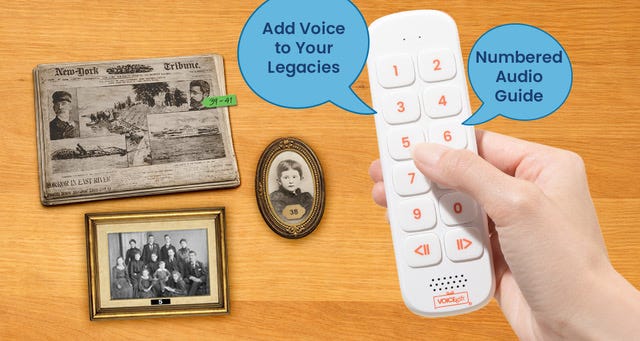
No App. No Cloud. No Waiting.
The most common question we were asked at the booth was:
“What’s the monthly subscription?”
It always made us smile.
Because the answer is: there isn’t one.
No app.
No cloud.
No passwords.
Just a voice—and a simple way to capture it.
Sometimes the most radical innovation isn’t adding complexity.
It’s removing it.
Three Things We Learned in Salt Lake City
If you wanted to understand where family history is headed, you didn’t need a keynote.
You just needed to listen.
1. The Gap Is Real
The people with the stories are not the people with the tools.
And unless we bridge that gap, we risk losing not just information—but identity.
2. Oral History Is Becoming the Gold Standard
There was a time when genealogy meant documents.
Now, it means voices.
Because knowing where someone came from is only half the story.
Knowing who they were—that’s the part that stays.
3. Physical Objects Still Matter
In a digital world, the things we hold onto are the things we can hold.
A voice that plays from a device.
A story that lives in a photo album.
A recipe that speaks as you cook.
These aren’t gadgets.
They’re portals.
Get an inside look into RootsTech 2026: The Future of DNA and Genealogy Podcast Ep out now!
The Future Is Not Digital or Physical. It’s Both.
At the end of the conference, as we packed up and replayed the conversations in our minds, one idea kept surfacing:
We are not moving from physical to digital.
We are moving from silent to spoken.
From static to alive.
From archives that tell us what happened
to memories that let us hear it happening.
A Final Thought
Take out an old photo album.
Flip through the pages.
Read the names scribbled on the back. The dates. The places.
And then imagine something more.
Imagine pressing a button…
and hearing that person speak.
Hearing them describe the moment.
Hearing them laugh.
Hearing them say your name.
That is not nostalgia.
That is possibility.
That is the future of memory.


Thank you, RootsTech.
To the hundreds of people we met: thank you for trusting us with your stories.
And to everyone reading this:
Don’t wait for the moment when you say,
“I wish I had done this ten years ago.”
Start now.
Because the most important part of your history…
is still speaking.
so touching!!!!!!!!!